

Social and Economic Empowerment (SEE) of Girls
Overview
Income
590'693 swiss francs
01.02.2026 - 31.01.2029
Yumbe and Koboko Districts, West Nile, Uganda
300 teenage mothers (aged 11–19 years old, 60% refugees, 40% host community members); 20 Mother-to-Mother mentors; 10 Community Support Groups
P260025
Project in detail
The West Nile sub-region in Northern Uganda faces significant educational and economic challenges that affect teenage mothers in refugee settlements and host communities. The region hosts approximately 1.9 million registered refugees and asylum seekers, 82% of whom are women and children under the age of 18, primarily displaced by the South Sudan crisis since 2013. Teenage pregnancy is a pronounced public health and social crisis within Uganda’s refugee settlements and host communities, including Bidibidi and Lobule in the West Nile sub-region of Northern Uganda.
The combination of displacement, poverty, and limited resources amplifies the challenges faced by adolescent girls, profoundly impacting their future and that of their children. Girls in the Yumbe and Koboko districts, particularly in the Bidibidi and Lobule Refugee Settlements, are dropping out of school at an alarming rate. A 2024 study indicated that nearly 34% of adolescent girls in refugee settlements in Northern Uganda have experienced pregnancy.
Educational access remains severely limited, with 76.5% of girls dropping out before completing primary education in Yumbe District and 50% of girls in Koboko District leaving school due to early pregnancy. After abandoning their education and lacking practical skills to generate income, these girls face extremely limited prospects for themselves and their children.
This project aims to create pathways to sustainable livelihoods and self-reliance for refugee and host community teenage mothers, as well as female persons living with disabilities (PLWD). It seeks to achieve this by facilitating (re-)entry into the formal education system and improving retention, while also strengthening participants’ vocational and business skills for income-generating activities.
The project addresses these challenges through a comprehensive approach targeting 300 teenage mothers aged 11–19 across the Bidibidi and Lobule refugee settlements and neighboring host communities. The intervention combines opportunities for re-entry into formal education with practical skills development through two core components.
The first component focuses on improving educational access and retention through Accelerated Education Programs (AEP), enabling 150 teenage mothers to re-enter the formal school system at both primary and lower secondary levels. The second component emphasizes economic empowerment by providing vocational skills training and apprenticeship placements for an additional 150 participants. These trainings cover market-relevant trades alongside business skills development.
The project employs the Gender Action Learning System (GALS) methodology to foster meaningful community engagement. It also incorporates financial literacy and entrepreneurship training to support sustainable income-generating activities, as well as reproductive and sexual health education and other essential life skills. Implementation includes the establishment of 10 Community Support Groups to promote long-term school retention, the provision of childcare support to enable participation in learning and training activities, and the training of 20 Mother-to-Mother mentors who will provide continuous guidance and psychosocial support to teenage mothers.
Further projects Commitment to a world without poverty

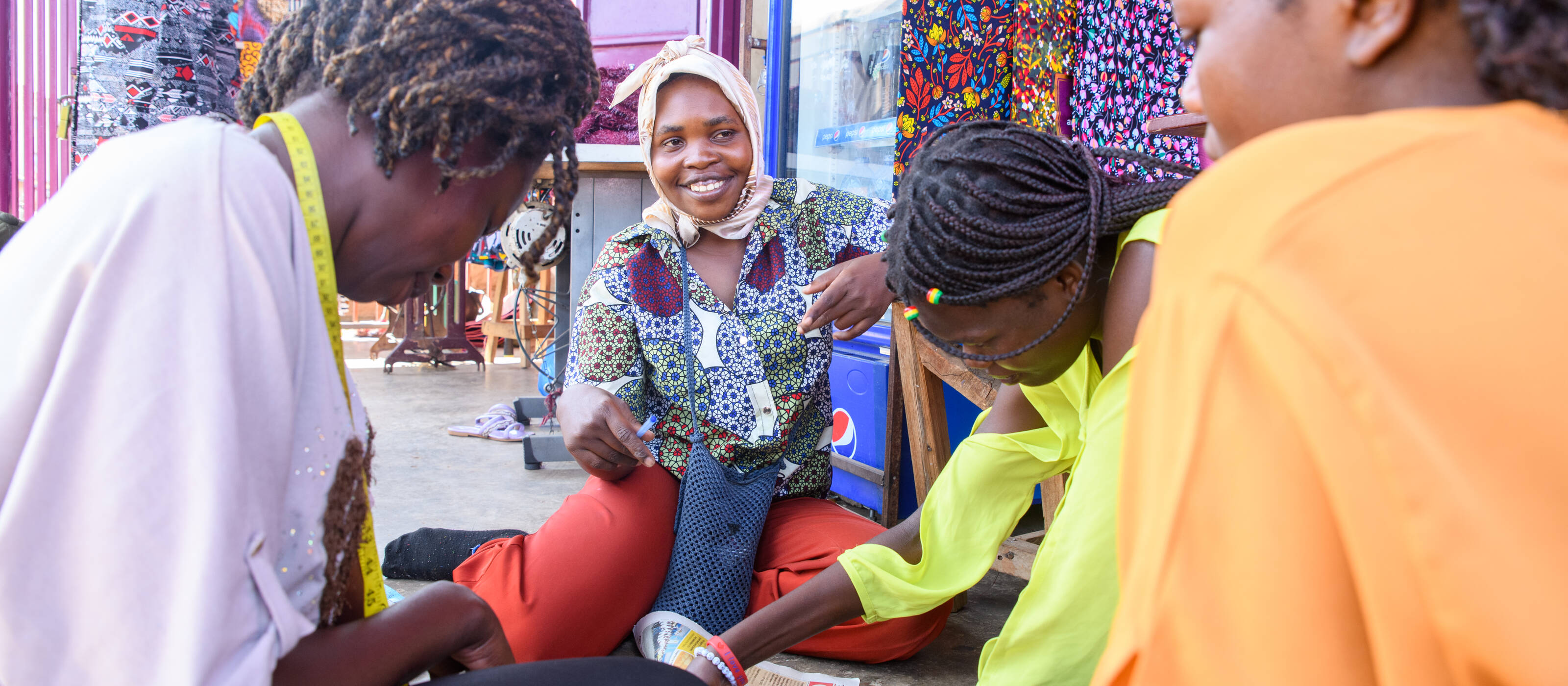
Header image: Young mothers need long-term prospects to be able to build an independent and sustainable source of income. © Emmanuel Museruka