

New UN Roadmap for Poverty Eradication
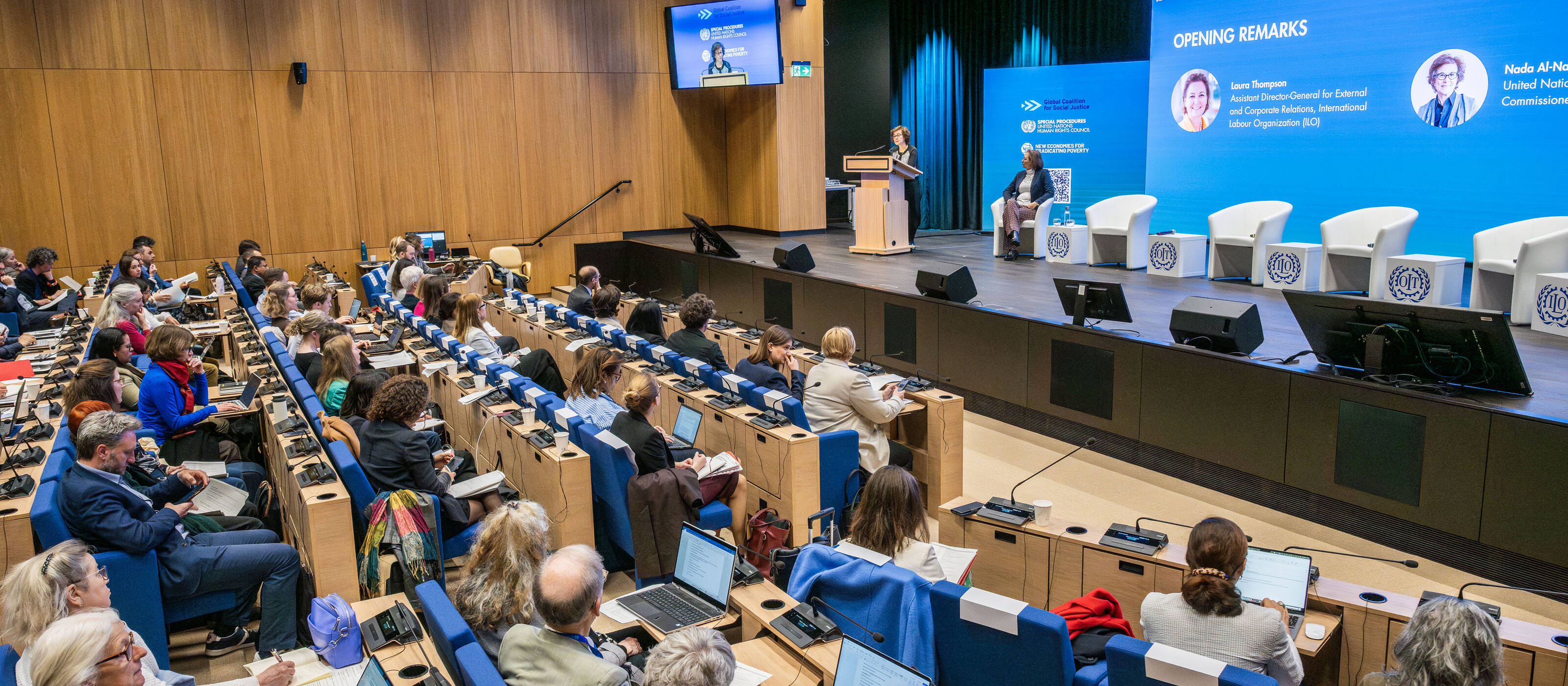
The UN Special Rapporteur on extreme poverty and human rights has launched a new Roadmap for Eradicating Poverty beyond Growth. The Roadmap contains a series of concrete policy measures and is intended to guide the international community in its fight against poverty. Caritas Switzerland attended the launch in Geneva and has assessed the Roadmap.
The international community’s goal is clear: by 2030, no one in the world should be living in extreme poverty – that is, on the equivalent of less than 3 US dollars a day. This is the first goal of the Agenda 2030 for Sustainable Development. However, the world is not on track to achieve this goal. According to World Bank estimates, by spring 2026 almost 830 million people – or one in ten – will still be living in extreme poverty. The climate crisis and rising social inequality are exacerbating the problem.
The new Roadmap by Olivier de Schutter, the United Nations Special Rapporteur on extreme poverty and human rights, is now set to bring us closer to achieving our goal of ending extreme poverty. The Roadmap for Eradicating Poverty beyond Growth was drawn up over the past year and a half in collaboration with various United Nations bodies, academic institutions and civil society organisations –– including various Caritas organisations.
Economic growth does not automatically reduce poverty
The Roadmap challenges the long-held belief that economic growth automatically reduces poverty. For decades, an increase in gross domestic product (GDP) has been regarded as a reliable indicator of progress, development and prosperity, as well as a measure of successful poverty reduction. However, research and the long-standing practical experience of civil society organisations clearly show that the expected automatic increase in prosperity for all has failed to materialise.
This is precisely where the Roadmap comes in, dispelling the notion that growth and progress are synonymous. It calls for a policy framework that puts human rights at its core, actively reduces inequalities, and respects planetary boundaries. Poverty reduction should be guided by criteria such as the common good, social justice and well-being, rather than GDP levels. The scientific evidence for this has long been available – what has been lacking is the political will to put these findings into practice.
To combat poverty and inequality effectively without relying on economic growth that is socially or ecologically harmful, the Roadmap outlines transformative measures. These include far-reaching changes such as a job guarantees, universal basic incomes, or tax sovereignty for all states. Such approaches open up avenues for reviving the values of solidarity and the common good: a renewed commitment to the goal of combatting poverty and reducing inequalities, which has been undermined by the relentless pursuit of economic growth.
Social assistance and international solidarity are two sides of the same coin
According to the Roadmap, social assistance and international solidarity are two sides of the same coin in the fight against poverty. States must provide social protection at home and fulfil their external responsibilities through fair economic rules and fiscal policy. International cooperation must eliminate structural disadvantages through debt relief, fair trade rules, coordinated tax policy, targeted climate finance, effective regulation of multinational corporations, and strengthening the economic self-determination of Global South countries. This requires a paradigm shift away from exploitative growth towards sustainable, socially just development. The Roadmap will be presented to the UN Human Rights Council in summer 2026, after which it will inform discussions on the Post-2030 Initiative, set to replace the Agenda 2030 in a few years’ time. Caritas Switzerland continues to monitor these processes, both as an active member of the civil society platform Agenda 2030 and through its representation on the federal government’s Agenda 2030 steering group.
More information
Header image: The Roadmap for Eradicating Poverty beyond Growth was presented and discussed at a UN conference in Geneva on 22 April. © Alioune Ndiaye/ILO