

The impact of Caritas Switzerland’s work
Every day, Caritas Switzerland devotes all its energy to supporting people in need and those experiencing poverty and to work together with them to sustainably improve their living situation.
- Does our work actually have the desired impact?
- What functions and how?
- Is there anything we could do better in future?
We aim to answer these questions through our impact assessment. This enables us to implement projects effectively, hold ourselves accountable to those affected and our supporters, and ensure our continuous development.
Thanks to the acquired knowledge about sustainable agricultural practices, the fields worked by this farmer in the district of Muminabad in Tajikistan have changed fundamentally between 2012 and 2020. The soil can absorb and store the water better, the risk of erosion and flooding has been substantially reduced.
Monitoring and evaluation
Monitoring – the regular measurement of project indicators – and evaluation – the selective, in-depth and mostly external analysis – are central to measuring the impact of our projects and programmes. The insights gained in this way influence how we adapt and further develop the projects and programs in the short and long term. At the same time, monitoring and evaluation are the basis for the reports to our funding partners.
Caritas Switzerland has a monitoring and evaluation system at the three levels of project, country programme and overall programme.
Projects are closely followed by our specialists on the ground and at head office in Lucerne. Regular visits, together with project indicators, form the basis of detailed reports which are produced half-yearly or annually about every project. The reports provide information about project progress, achieved impact, the budget and the challenges. They also point out options for action if necessary.
In addition, most projects are evaluated by external specialists halfway through and at the end of the project period. This process assesses factors such as the project’s relevance, cost-benefit ratio, and sustainable impact, and proposes potential improvements and adjustments.
Country programmes and overall programmes are monitored using standard indicators and metrics and are also periodically evaluated.
Two key aspects in monitoring and evaluation are the internal learning processes and knowledge transfer.
Employees in the field systematically collect their findings, experiences and samples in the projects. The learning processes aim at a continuous improvement and development of our projects and programmes. The findings are also used for planning and managing successive phases or similar projects. They are freely available to all projects and countries.
We actively and systematically share the acquired knowledge with our partners internally and externally. On the one hand, knowledge gained is processed, summarized and disseminated in the form of thematic papers, and on the other hand, various internal and external exchange forums are available.
The impact of our work
0
peoplehave a KulturLegi and thus have discount for culture and sport
(2025)
0
advice sessionscould be conducted by the Caritas debt advice service
(2025)
0
peoplewere able to improve their working conditions or their income
(2025)
0
peoplecould meet their basic needs in a humanitarian crisis
(2025)

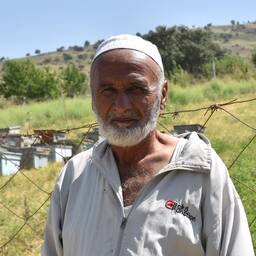
«Thanks to the training provided by Caritas Switzerland, people care about nature again and replant forests. Because they protect us against erosion and natural disasters.»Rahmonov MurodaliFarmer, Tajikistan
A collection of different evaluations

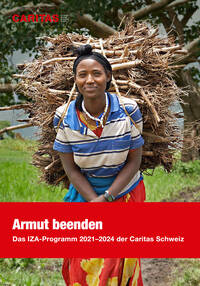
Measuring the impact in international cooperation (German)
Extract from the 2021-2024 strategy of Caritas Switzerland’s international cooperation with regard to impact measurement.
Download (pdf, 5.92 MB)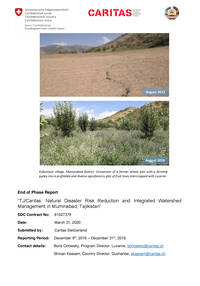
Final report «Natural Disaster iRisk Reduction and Integrated Watershed Management, Tajikistan»
Detailed analysis of the 9-year project, which specifically identifies the knowledge gained for further projects.
Download (pdf, 2.26 MB)
Evaluation of CHAST Programme, Ethiopia
Detailed evaluation by the Swiss Tropical Institute of Caritas Switzerland’s approach to training children with regard to hygiene (CHAST, Children’s hygiene and Sanitation Training).
Download (pdf, 1.12 MB)
Impact analysis Swiss Solidarity Haiti earthquake (French)
Analysis of the emergency relief projects, delivered also by Caritas Switzerland, supported by Swiss Solidarity after the earthquake in Haiti in 2010.
Download (pdf, 13.62 MB)More information
Header image: Caritas employees in Tjikistan, 2021 © Abdullo Media