

Conservation and Sustainable Management of High-Value Arid Ecosystems in the Lower Amu-Daryafinished
Overview
Climat
248'114 Swiss Francs
01.06.2025 - 30.11.2025
Western Khatlon Province
Rural population, district governments
P250001
Global Environment Facility (GEF); United Nations Development Programme (UNDP)
Project in detail
The majority of Tajikistan’s territorial area is within the “Mountains of Central Asia” biodiversity hotspot, including the foothills of the lower Amu Darya landscape in Khatlon province. The lower Amu Darya landscape provides numerous ecosystem services. Khatlon province is home to large shares of Tajikistan’s agricultural production, including crops, vineyards and livestock. The Amu Darya River, along with multiple other tributaries, provide critical water for irrigation, and through hydropower facilities also provide large amounts of energy for domestic use and for export.
The major threats to high value arid ecosystems in Tajikistan’s lower Amu Darya landscape are:
- overgrazing (leading to land degradation, and loss of biodiversity)
- unsustainable practices for agriculture (also leading to erosion and other forms of land degradation)
- illegal cutting of forests (most commonly for fuelwood)
- and illegal and unsustainable grabbing of natural resources (eg. poaching, in various forms).
The root cause of the majority of these threats is abject poverty within rural areas of Tajikistan. Development initiatives in this area therefore must target both an immediate relief for rural livelihoods and more systematic (institutional) changes towards sustainable management of natural resources.
Aiming for long-term sustainable development and conservation of the targeted high value arid ecosystems, the project has multiple key goals. These include the effective conservation of biodiversity, and the maintenance of critical ecosystem services, including the productivity of lands for agricultural use. These ecological goals must be achieved within the context of supporting and securing sustainable and resilient livelihoods for local resource users, whose daily existence depends greatly on the integrity and productivity of these ecosystems. A long-term solution is one where government resource managers and local communities plan and implement integrated natural resource use practices that are biodiversity friendly, and support healthy soil and vegetation, while at the same time ensuring immediate and long-term economic benefits for participating farmers.
While the project is primarily implemented through agencies from the national government, notably the National Center for Biodiversity and Biosafety (NBBC) under the coordination of UNDP in Tajikistan, CACH assumes a technical backstopping and facilitating role to leverage its vast experience in sustainable agriculture and land use management practices. Building on hallmark approaches, CACH supports the project to achieve its ambitions in the areas of land use planning at district level, dry-land and land restoration through sustainable land-use management practices for both agriculture and pastures. CACH’s previous presence (under thematically related initiatives) in several of the target region’s districts and effective working relationships with district governments and agencies become instrumental for effective implementation.
Further projects Commitment to a world without poverty


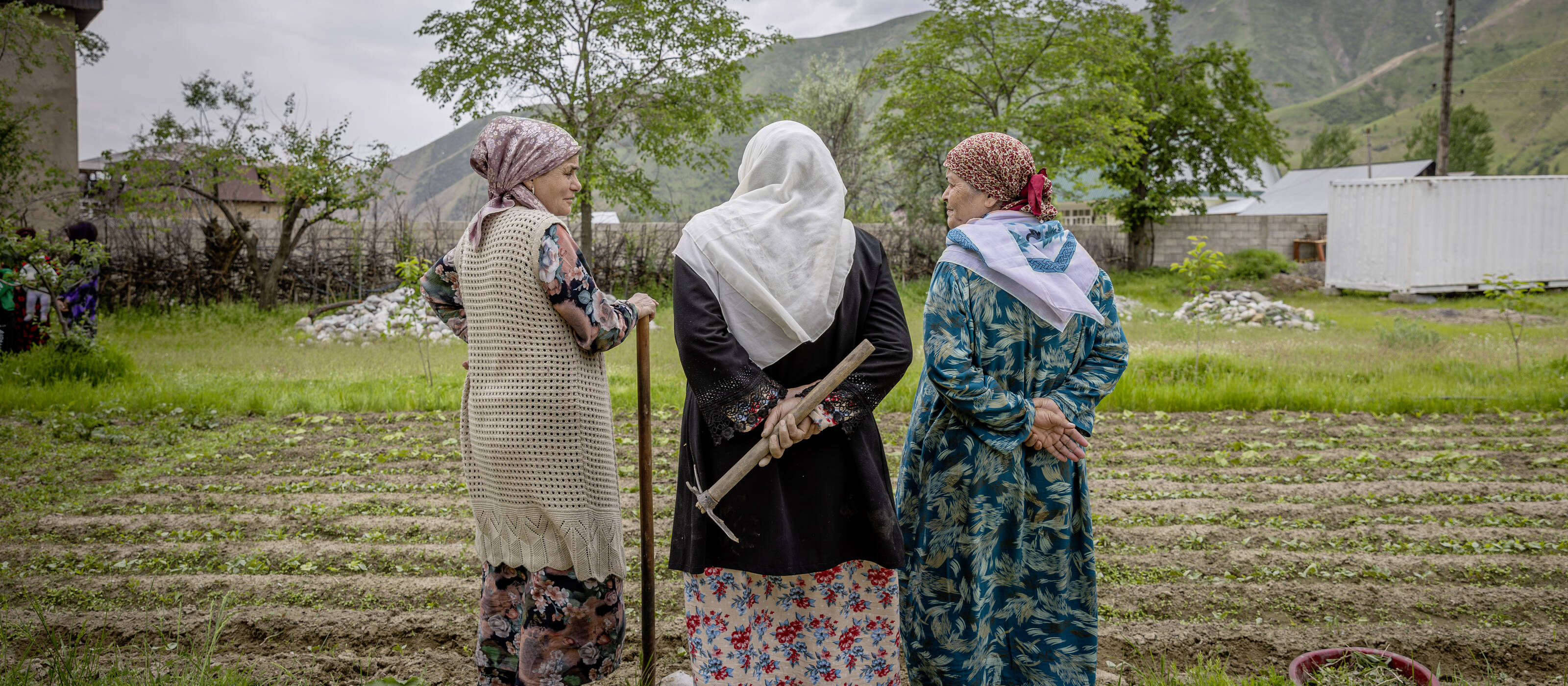
Header image: Ms. Gulrukhsor Nazimova (second from the left), 57 years old, is the leader of the "Faiz" women production group, locally helping with agriculture. © Reto Albertalli