

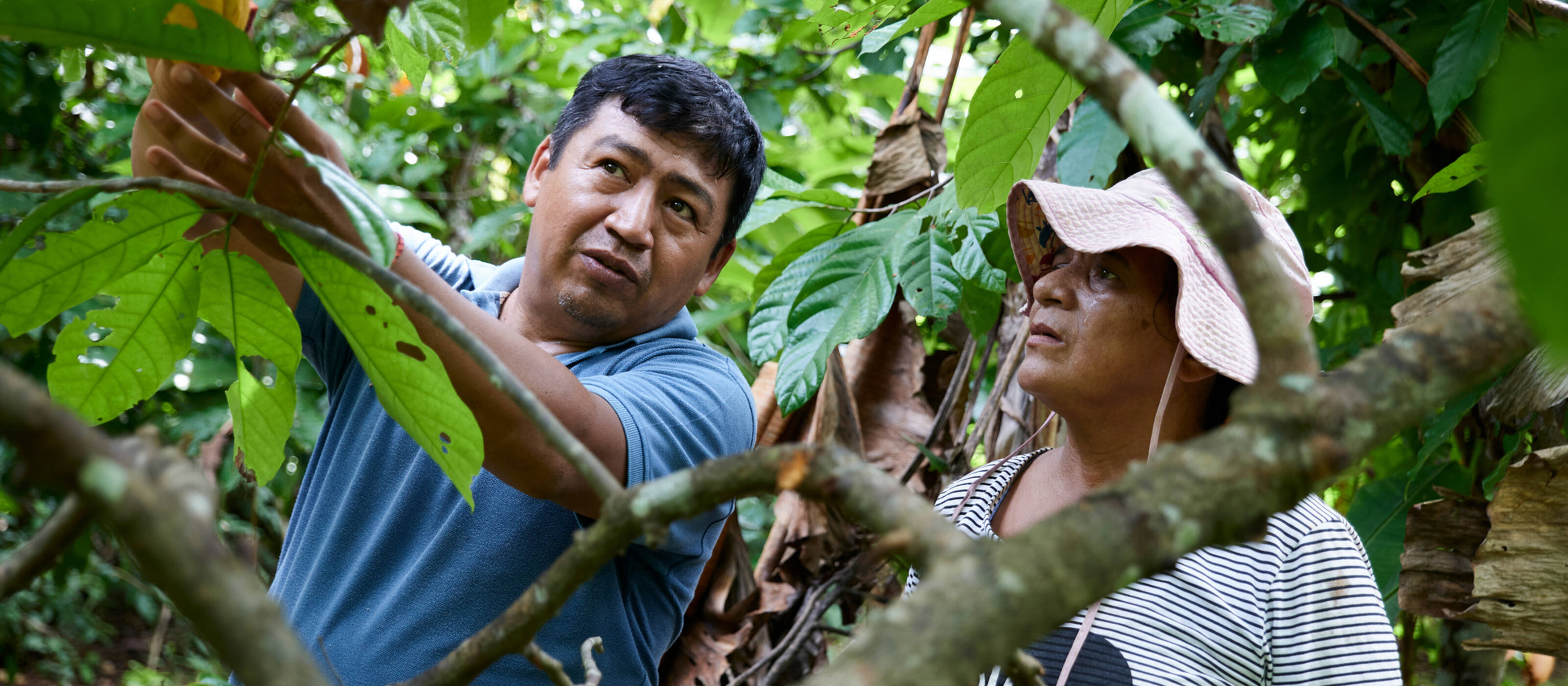
Bolivia
In Bolivia, a lack of traceability and limited access to financing make it difficult for many cocoa producers to enter higher-value markets. Cacao 360 is working with 150 producers to test digital solutions and appropriate microfinance models—to promote more sustainable production, improve market opportunities, and increase incomes in the long term.
Overview
Income
CHF 134'049
17.08.2026 - 30.06.2027
Palos Blancos, Alto Beni (department of La Paz)
150 cacao producers in agroforestry systems in Palos Blancos
P260045
Swiss Cacao Platform / SECO Embassy of Switzerland in Bolivia
Project in detail
Cocoa producers in Alto Beni and Palos Blancos face several interconnected challenges that limit their access to higher-value markets and their ability to improve their livelihoods. Cocoa is largely produced in environmentally sustainable agroforestry systems and is of potential interest to specialised international buyers. However, producers often lack the traceability systems, verified production data and financial services increasingly required by markets and regulations such as the European Union Deforestation Regulation (EUDR).
Access to credit is also constrained. Financial institutions have limited information about producers' productive capacity and therefore face difficulties assessing risk, while farmers lack financing tailored to cocoa production cycles. Further challenges include gaps in technical, financial and commercial capacities, as well as barriers that affect women's participation and access to economic opportunities.
The overall objective of Cacao 360 is to enable cocoa-producing households in Alto Beni and Palos Blancos to improve their well-being and economic resilience and move towards sustainable livelihoods and living incomes. Together with producers, the project will assess, adapt and pilot digital and financial solutions that improve environmental sustainability, support progress towards traceability requirements and explore access to microfinance tailored to cocoa production cycles. It will also generate evidence for the future adoption and scaling of successful approaches.
The project will first assess the needs, capacities and constraints of cocoa producers and other value-chain actors, with particular attention to traceability, sustainability, market access and financial inclusion. Based on these findings, it will evaluate and pilot digital traceability solutions that can support environmental compliance and generate reliable production and geographical data. In parallel, a data-management system previously designed for coffee production will be adapted and tested for cocoa.
Working with financial institutions, the project will also develop a microfinance model aligned with cocoa production cycles and supported by a seed-capital mechanism. Technical assistance on sustainable cocoa production, agroforestry and climate adaptation, together with training in financial literacy, digital tools, commercialisation and market requirements, will strengthen producers' capacities.
Overall, the project aims to reach 150 cocoa producers with solutions that improve traceability, access to suitable financial services and opportunities in higher-value markets. Lessons from the pilots will be documented and shared to support future replication and scaling in the cocoa sector.
Further projects Commitment to a world without poverty


Header image: © Fabian Biasio