

Your will
Would you like to do good beyond your lifetime and let your solidarity and humanity live on? In addition to your loved ones, you can also leave a gift to Caritas Switzerland in your will. By doing so, you will leave a legacy that will change lives because millions of people are still affected by poverty.
Leaving a lasting legacy
in German
Bequests are an important source of donations for Caritas Switzerland. By considering a charitable organisation such as Caritas Switzerland, you can leave something lasting. Your contribution will support our work over a longer period of time, and you can be sure that your donation will go where you want it to.
Caritas Switzerland has been in existence for 120 years. It has always been important for us to look after legacies with great care. Transparency and openness are key concerns for us. We would be happy to discuss with you how and where you would like to use your legacy.
By naming Caritas Switzerland as a legatee or as an heir in your will. A will is mandatory for this.
No, as a charitable relief organisation, Caritas Switzerland is exempt from inheritance tax. Donations from a will go directly to our projects.
Drawing up your will
Show gratitude for your life and make a difference after your death: a will allows you to decide for yourself how your estate should be distributed so that your values can live on and can help to shape the future.
Our online guide takes you step-by-step through the process of drawing up your will. It explains who is entitled to legally protected reserved portions and what amounts you are free to gift.
How to proceed:
- Create your personalised will template online, free of charge.
- Please note: In order to ensure your will is legally valid, it must be copied by hand and signed and dated.
- Store your will with the relevant municipality or a notary, or in a safe place at home where it will be easy to find.
Questions and answers
If you answer yes to the following statements, you need a will so that your wishes can be realised after your death.
- I would like to decide for myself what should happen to my savings one day.
- I would like my partner, to whom I am not married, to receive part of my inheritance.
- I want to include other people or organisations in addition to my family.
- I have no legal heirs and do not want my entire inheritance to go to the state.
Please note that
- Children, spouses and registered partners are among your legal heirs and are entitled to a statutory compulsory portion.
- You can freely dispose of a certain portion of the inheritance in addition to the statutory compulsory portion (free quota).
- you can use this free inheritance share to include close relatives or an organisation you trust, for example.
- if no direct relatives can be found and you do not write a will, the entire estate goes to the state.
In this case, the statutory order of succession applies. The law regulates which relatives are entitled to which share of an inheritance. Without a will, it is not possible to bequeath part of your estate to people or organisations close to your heart.
Without a will, Swiss inheritance law regulates who is entitled to your inheritance and in what order. First in line are the surviving spouse or registered partner and direct descendants such as children, grandchildren, and great-grandchildren. If no direct relatives can be found and you do not write a will, the entire estate goes to the state.
Compulsory portions are minimum shares for legally protected heirs that cannot be bypassed. If the compulsory portions are deducted from the estate, the so-called free quota remains. You can distribute this as you wish. For example, you can use it to benefit a close relative who is not protected by law to receive a compulsory portion, or an organisation that is close to your heart.
Please note: Cohabiting partners, non-adopted stepchildren, siblings, or parents are not protected by law. However, you can include them in the free quota in your will.

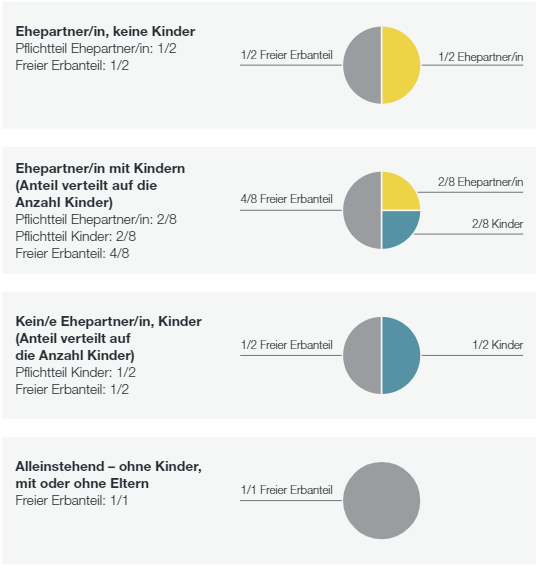
The following heirs are protected by compulsory portions:
- Natural children
- Spouses and civil partners
- Registered partners and registered partners
A will is legally valid only if it is handwritten, personally signed and dated. If it is not possible for you to write the will by hand, it must be endorsed by a notary.
Of course, you can change or cancel your will at any time. It is important that you state in writing that earlier versions are no longer valid or have been destroyed by you personally. Any changes to existing wills must also be dated and signed by you.
Your will must be easily accessible and easy to find. You should also leave a copy with a trusted person, a lawyer, or your local authority.
The compulsory portions cannot be avoided. If you deduct them from the estate, you will receive the free quota, which you can dispose of freely. This allows you to include close friends, people from your patchwork family, non-adopted stepchildren, unmarried partners, or organisations that are close to your heart. However, this is possible only if you draw up a legally valid will.
You must list these people or organisations as legatees or heirs in your will. A will is mandatory for this. You must always comply with the compulsory portions.
In the case of a childless couple, without a will, three quarters of the estate goes to the surviving spouse, in accordance with the statutory order of succession. The remaining quarter goes to the testator's parents or, if they are no longer alive, to their siblings and, after their predecease, to their nieces and nephews.
With a will, you can leave everything to your spouse without restriction.
The support of a lawyer or notary is helpful in the case of complex financial circumstances. In principle, however, a handwritten, signed and dated will is sufficient.
With an inheritance, you bequeath part of your estate. Thus, Caritas Switzerland, for example, could become a co-heir. This inheritance share is usually expressed as a percentage.
In contrast, a bequest (legacy) is a fixed amount, e.g. CHF 10,000 or a defined tangible asset (such as securities, jewellery, works of art, real estate).
Download
in German

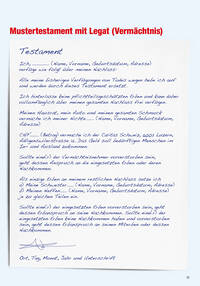
Mustertestamente
Die beiden Mustertestamente können Sie als Vorlage für Ihr eigenes Testament nutzen. Damit das Testament rechtlich gültig ist, muss es von Hand abgeschrieben und, versehen mit Ort und Datum, unterzeichnet werden.
Download (pdf, 914.21 KB)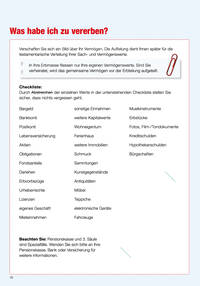
Liste zu Vermögenswerten
Die Musterliste zu Vermögenswerten hilft Ihnen dabei, ein Bild über Ihren Nachlass zu erhalten.
Download (pdf, 288.6 KB)Would you prefer to use printed brochures and templates to prepare your care documents? The Caritas Care Folder can help you with this. The folder contains information brochures, patient decree forms and a guide to drawing up your advance care directive and your will, as well as a document for directives in the event of death.
We will be happy to send you the Care Folder in the post in return for a small contribution towards the costs of production and postage.
Further information


Bernhard Leicht
Head of inheritances and leagacies+41 41 419 24 69bleicht@caritas.ch
If you have any questions or would like to talk to me, I shall be happy to help you. Please contact me without obligation. Your questions will be treated with the utmost discretion. I shall be happy also to answer any questions that you may have about our work and projects.
Header image: © Pia Zanetti