


White Paper: Integrating the Market Systems Development and Graduation Approaches
The Graduation Approach (GA) has helped millions of households move out of extreme poverty by strengthening their resilience, livelihoods, and economic capacities. Yet lasting progress depends on more than household-level support—it also requires access to inclusive and well-functioning economic systems that continue to create opportunities long after projects have ended.
This White Paper explores how the Graduation Approach and Market Systems Development (MSD) can work together to create more sustainable pathways out of poverty. While the Graduation Approach equips people to participate in markets, MSD strengthens market systems, making them more inclusive, responsive, and resilient. Together, these complementary approaches can bridge immediate poverty reduction with long-term systemic change.
Drawing on practical experience from humanitarian, development, and peacebuilding programs across Africa, Asia, Latin America, and Europe, the paper argues that sustainable poverty reduction requires both resilient households and market systems capable of supporting long-term economic participation. The paper proposes a practical framework for integrating household-level support with systems of change, while emphasizing inclusion, social cohesion, conflict sensitivity, and resilience.
Discover how combining household-focused and systems-focused approaches can deliver more durable and inclusive development outcomes in our White Paper.
Download White Paper

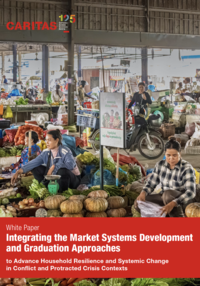
English: White Paper «Integrating the Market Systems Development and Graduation Approaches»
to Advance Household Resilience and Systemic Change in Conflict and Protracted Crisis Contexts
Download (pdf, 2.47 MB)
Español: Informe técnico «La integración de los enfoques de desarrollo de sistemas de mercado y del modelo de Graduación»
para fomentar la resiliencia de los hogares y el cambio sistémico en situaciones de conflicto y crisis prolongadas
Download (pdf, 2.43 MB)
Français: Livre blanc «Intégrer les approches de développement des systèmes de marché et de graduation»
pour renforcer la résilience des ménages et favoriser un changement systémique dans les contextes de conflit et de crise prolongée
Download (pdf, 2.43 MB)
Arabic: White Paper «Integrating the Market Systems Development and Graduation Approaches»
to Advance Household Resilience and Systemic Change in Conflict and Protracted Crisis Contexts
Download (pdf, 2.49 MB)Why integrating the Graduation Approach and Markets Systems Development?
The integration of these two approaches is based on the premise that they are not competing alternatives but complementary strategies that address different dimensions of poverty and exclusion. Graduation prepares people for markets by strengthening household capabilities and resilience, while MSD ensures that markets are prepared for people by creating more inclusive, responsive, and sustainable economic systems. Together, they bridge the gap between household-level poverty reduction and long-term systemic change.
How to integrate the Graduation Approach and Market Systems Development?
The white paper proposes three practical integration pathways, which will be presented and discussed during the webinar:
- Graduation as an Entry Point to Market Systems
- Designing MSD for Poor and Vulnerable Populations
- Integration by Design
Which operational considerations and challenges arise when integrating Market Systems Development and the Graduation Approach?
Integrating the Graduation Approach and Market Systems Development raises interlocking challenges. "Market-readiness" is often misframed: vulnerable households already participate in markets, so the real constraints are risk-averse coping, low trust, and subsidy-driven dependency. Poorly designed interventions can distort thin markets, oversaturate weak value chains, or expose participants to exploitation. Underlying it all is the need for deliberate sequencing and market analysis so households don't graduate into markets that can't sustain them. Where private sector actors are limited or absent, a critical entry point is strengthening cooperation among market actors — focusing on how individuals and groups collaborate, build trust, share information, and overcome barriers to collective market participation.
Further information on our engagement
Get in contact with our experts on Migration and Income & Livelihoods


Sarah Estermann
Senior Advisor and Knowledge Manager MigrationCaritas SwitzerlandSwitzerland
+41 41 419 23 28sestermann@caritas.ch


Maciej Chmielewski
Senior Advisor and Knowledge Manager Income & LivelihoodsCaritas SwitzerlandSwitzerland
+41 41 419 23 71mchmielewski@caritas.ch
Co-authors, Contributors and Supporting Organizations







Header image: Promoting local organic products at a market in Cambodia © Nicolas Honoré