

Empowering Rural Communities through Nano-Grid Electrification in Borenafinished
Overview
Climate
143'933 swiss francs
01.12.2025 - 30.04.2026
Dire Woreda, Borena Zone, Oromia Region, Ethiopia
9 Public institutions in Megado Kebele whose services are accessed by around 12’000 individuals
P250054
giz Deutsche Gesellschaft für Internationale Zusammenarbeit (GIZ) GmbH; DEZA Swiss Agency for Development and Cooperation SDC

Project in detail
Over 65 million Ethiopians lack access to electricity, especially in rural areas. Despite ongoing grid expansion, last-mile access remains limited due to insufficient public funding and infrastructure gaps. Decentralized alternatives, such as mini-grids and solar home systems (SHS), struggle with scalability, flexibility, and sustainability. This persistent energy poverty reduces productivity, hinders essential service delivery, and limits economic opportunities, particularly for women and youth.
To address this, Caritas Switzerland and Power-Blox AG have partnered to promote off-grid electrification and support climate-resilient rural enterprises in Ethiopia. In 2023/24, the “Energy for Rural Start-Ups (EnerSU)” initiative piloted over 25 nano-grid units in three districts, delivering power to schools, clinics, and micro-enterprises. The successful proof-of-concept phase confirmed the potential of the technology as well as the partnership between Caritas Switzerland and Power-Blox AG, in which Power-Blox AG contributes the core technology and provides support in training, business development, and quality assurance. Caritas Switzerland manages community access, liaises with local government, and oversees grant administration. The successful pilot also sparked interest from EnDev, a strategic global partnership of like-minded donors and partners supporting access to modern energy, which would like to support further demonstrations to explore the project’s fit within the EnDev programme.
The project will improve access to energy for nine public institutions in Dire, where electric power is currently insufficient to non-existent. Addressing these energy gaps will not only improve community well-being and public service delivery but also enhance safety and productivity for a population composed of both host and refugee communities. The intervention is expected to benefit both direct users and indirect beneficiaries by improving energy access and enhancing the functionality of public institution services.
Nine public institutions will gain access to off-grid energy through the provision of PBX-200 technology. At the core of the technology is a lithium iron phosphate battery that can be charged from various sources – the project will promote the use of solar panels. The system is modular, allowing several batteries to be stacked and connected, and features a simple plug-and-play design that enables easy access to stored energy at any time and at the required scale. Due to its scalability, the technology is well suited to the nano-grid space, which is larger than a home system but less investment-intensive and more flexible than mini-grids. The energy can be used both for economic activities and, as in this project, for the delivery of services that function better with power, such as education with access to information technology, and medical services with adequate lighting and cooling, to name just a few examples. Within this project, 22 PBX systems with appliances will be distributed to nine public institutions, including schools, human and animal health centres, and post offices.
Further projects Commitment to a world without poverty

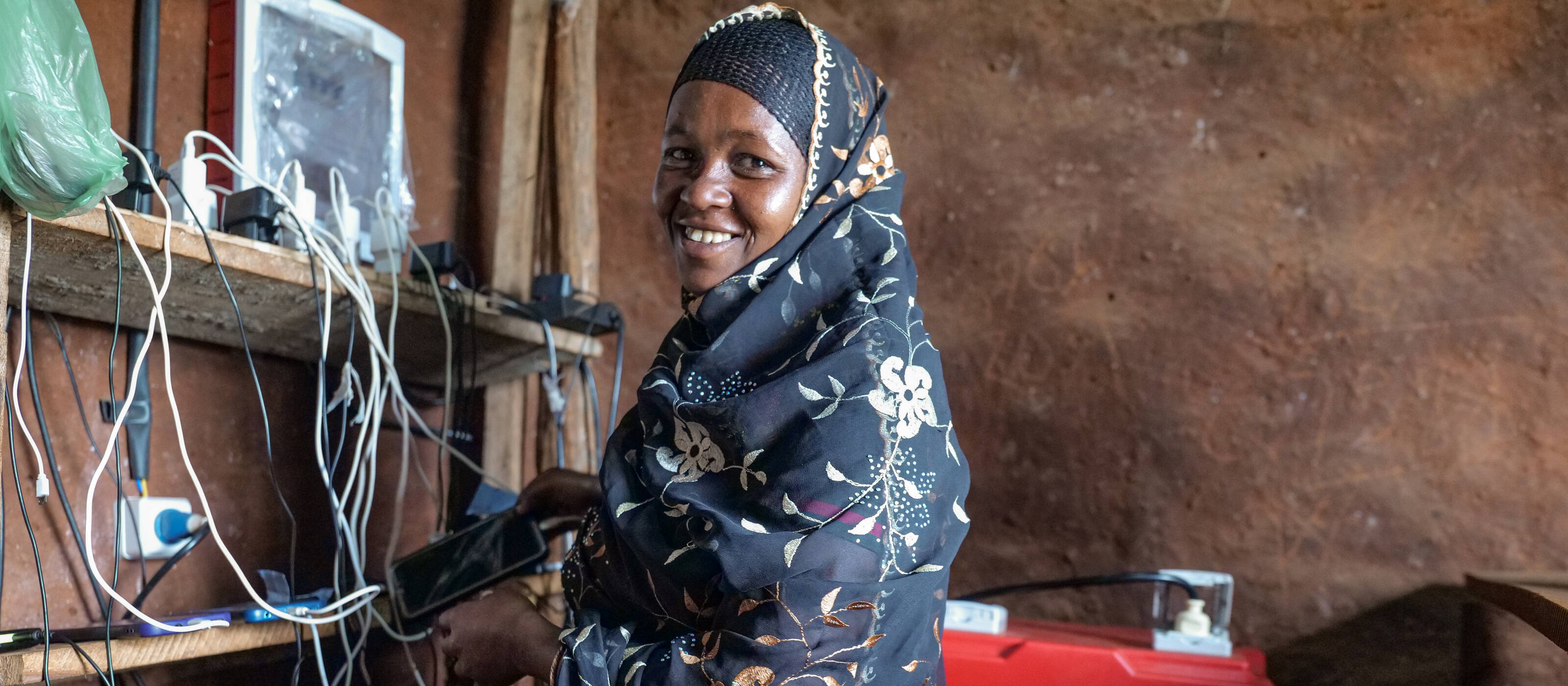
Header image: Electricity is also of central importance to the people of Borena for economic activities. © Ayaana Publishing