Better food security in Haiti’s North-Westfinished
Project in detail
The food situation In Haiti is generally precarious. The poorest country in the Western hemisphere cannot provide food security for half its population. 80% of the population live below the poverty threshold, three quarters of them in rural areas. Undernourishment and malnutrition are widespread. The country’s economy is very weak and the political system very unstable. Devastating natural disasters exacerbate the situation massively. The project area in the Département Nord-Ouest is among the poorest regions. As well as facing structural disadvantages, the three target communes of Port-de-Paix, Anse-à-Fôleur and Saint-Louis-du-Nord are also particularly hard hit by the after-effects of the recent hurricanes, recurring droughts and regular flooding.
In the project area, nearly 50% of the population are at risk of acute undernourishment or malnutrition. Due to rising prices, poor families can no longer afford nutritious food. In the affected communes, five per cent of children below the age of five suffer from acute malnutrition and 22% from chronic malnutrition. Chronic malnutrition in children leads to stunting and even developmental disabilities.
In the communes of Port-de-Paix, Anse-à-Fôleur and Saint-Louis-du-Nord, the project promotes the development of services that enable the poor population to sustainably secure their food supplies. Agricultural production is increased through improvements in governance.
The project promotes joint watershed management. All actors whose water supply is linked to a particular water course are included. Priority is given to protect the lands against erosion. To raise awareness among the young generation, events about nutrition, hygiene and food products are organised in 15 schools.
The availability of and access to food are improved by strengthening value chains. The procurement, storage and commercialisation of seeds is coordinated by local aid organisations. The project also promotes the setting up of micro-enterprises within the framework of the local self-help groups and restores important roads to ensure access to the markets.
In cooperation with local health centres, the project distributes vouchers to families with particularly undernourished and malnourished children. They can exchange the vouchers for food in the local markets.
The diversification of sources of income and the protection of the soils strengthens the population’s resilience.
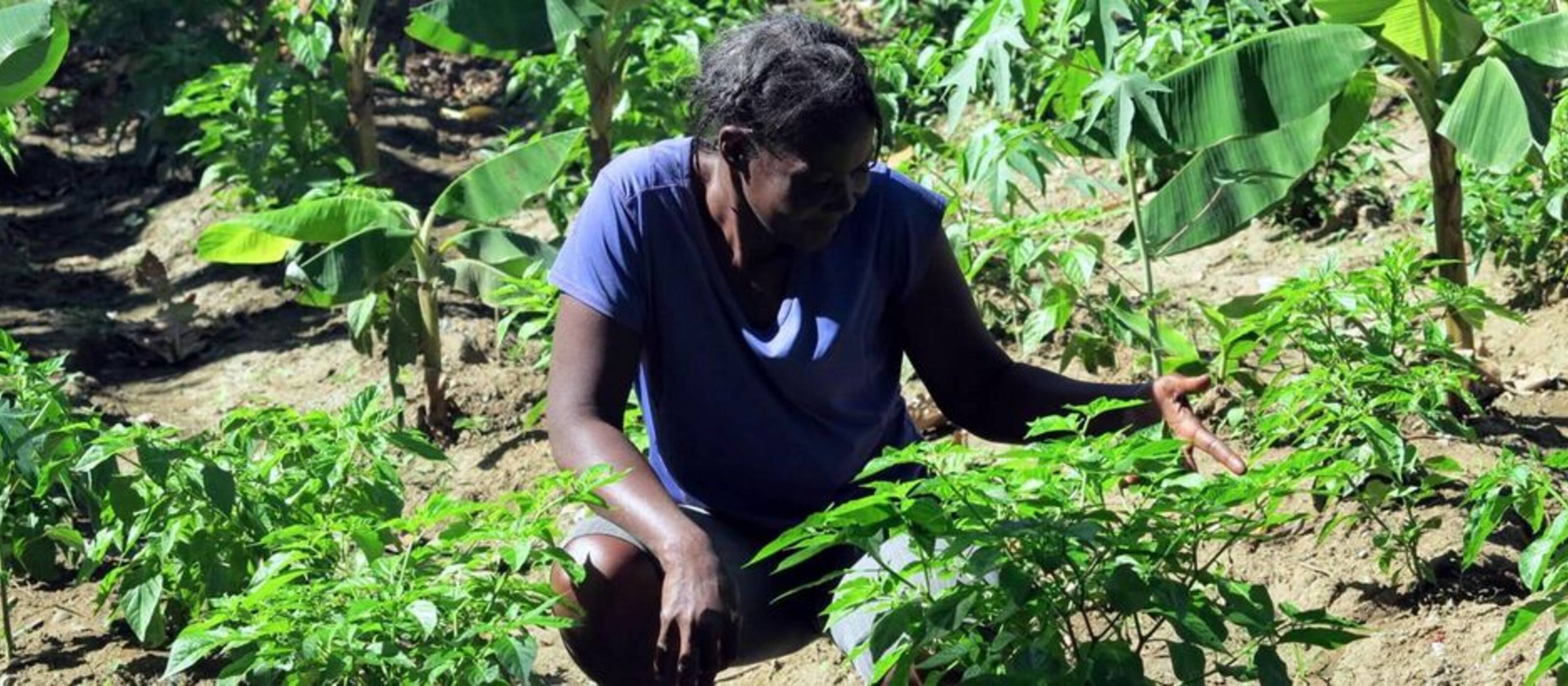
The project aims to improve the income of the beneficiary families, but also takes into account the climate issue, as agriculture must be promoted in an ecological way to achieve sustainable improvement. With the ‘terra preta’ technique, soils can be fertilised with production and kitchen waste, charcoal and animal excrement and made fertile again.
Agroecological approaches and agroforestry make it possible to increase food production without depleting the soil and other important resources. The methods applied in the framework of ‘Make Markets Work for the Poor’ can be used to analyse the market systems in the project area holistically, so that changes can be made where they will benefit the vulnerable population groups. Caritas Switzerland is implementing the project in close cooperation with the local government and community committees and is working with two local partner organisations that are well established in this field.
Facts and figures
Revenue
CHF 6'640'606
Haiti, Département Nord-Ouest, communes of Port-de-Paix, Anse-à-Fôleur and Saint-Louis-du-Nord
- 3,000 families with malnourished children,
- 3,000 pupils,
- 300 market traders,
- 3,095 additional people and
- 5,130 beneficiaries of the cash-for-work programme
In total, 14'525 households are direct beneficiaries of this project.
SDC, EU*
*This is funded/co-funded by the European Union. Its contents are the sole responsibility of Caritas Switzerland and do not necessarily reflect the views of the European Union.