


KAPCYM Unit: Platform for Professionals
The Knowledge and Policy Dialogue on Protection of Children and Youth on the Move (KAPCYM) Unit, established in 2024, has been mandated by the Swiss Agency for Development and Cooperation (SDC) to enhance Switzerland's positioning on Migration and Child protection. Operating independently of operational responsibilities, KAPCYM supports and complements the two projects «Programme Enfants et Jeunes sur les Routes Migratoires d’Afrique de l’Ouest et du Nord» (EJM) and «East African Migration Routes» (EAMR), both financed by SDC.
KAPCYM contributes to a more strategic approach to Swiss partners’ policy advocacy messages and approaches by fostering a community of practice, regional synergies and exchanges of evidence-based lessons learnt and good practices, with a participatory and gender-transformative approach.


KAPCYM follows a three-tiered process proposed by Caritas Switzerland, which is designed to deliver impactful change:
Ensuring that critical knowledge from ongoing projects and initiatives is captured, synthesized, and made accessible for decision-makers, practitioners, and other stakeholders.
Facilitating robust channels for sharing insights and fostering mutual learning among stakeholders to improve the effectiveness of interventions and policies.
Supporting Switzerland and its partners in advancing advocacy efforts and contributing to stronger policy dialogue on the protection of children and youth on the move.
KAPCYM Publications
Thematic Briefs include key advocacy messages to support advocacy activities and policy dialogue, grounded in good practices and lessons learned from the EJM and EAMR Projects, and from a variety of governmental actors (Swiss and other national authorities).
Advocacy Strategies lay out the approach for communicating the advocacy messages outlined in the thematic briefs and include the target audience for advocacy efforts on the specific priority topic as well as recommendations on advocacy channels.
Both documents are designed to support Switzerland’s advocacy and policy dialogue efforts, particularly of WoGA actors as well as the EJM and EAMR Projects.
KAPCYM Overview Documents
General documents about the KAPCYM Unit
- KAPCYM Strategy: Document outlining the strategy and main activities of the KAPCYM unit (updated in November 2025)
- KAPCYM Results Framework: The KAPCYM Results Framework is based on three pillars: a) knowledge collection, synthesis, and documentation; b) knowledge dissemination and learning; and c) advocacy and policy dialogue.
KAPCYM Events
On 3 and 4 March 2025, the KAPCYM Unit brought together key project stakeholders to: a) present the key findings of its mapping phase, which include actors, networks, priorities, andgaps, conducted as part of its efforts to strengthen evidence-based policymaking and practice in the protection child and youth on the move in East, West and North Africa; and b) refine the priorities identified and collaboratively discuss and validate how these priorities will inform the achievement of the project’s objectives.
Click on the links below to access the workshop documents.
On 11 December 2025, the KAPCYM Unit conducted an online workshop, with the main aim of operationalizing the first KAPCYM advocacy strategy based on the respective thematic brief. Participants were approximately 50 staff from WoGA, EJM and EAMR (incl. extended consortia partners) engaged in advocacy work.
You can find documentation of the workshop, as well as the different advocacy action sheets, by clicking on the links below.
Advocacy Action Sheets:
The KAPCYM Unit conducted a workshop with WoGA (whole-of-government approach) actors in order to identify concrete opportunities for advocacy and policy dialogue on global level.
The slides of the workshop as well as the advocacy action sheet can be found below.
On 20 April 2026, KAPCYM organized a webinar presenting Thematic Brief & Advocacy Strategy #2 («Strengthening Regional Cooperation on Case Management Systems»). In addition, a panel discussion brought together different practitioners from the EJM and EAMR Projects as well as from the Alliance for Child Protection in Humanitarian Action.
The slides of the webinar as well as the article about the workshop can be found below.
On 18 June 2026, KAPCYM organized a webinar presenting Thematic Brief & Advocacy Strategy #3 («GBV in a Migration Setting»). In addition, the webinar had a focus on the EJM Project, with a moderated discussion bringing together practitioners from West Africa - from MAEJT in Niger and the NGO Tilé Coura in Mali.
The slides of the webinar, agenda and list of participants can be found below.
This webinar will have a focus on the EAMR Project, as the webinar of 18 June focused on the EJM Project.
More information about our initiatives
The KAPCYM Unit actively engages with different networks and other stakeholders working on the protection of children of CYM and participates in discussions, events, and knowledge-sharing opportunities. The projects EJM and EAMR as well as Swiss WoGA actors are encouraged to join and actively contribute to these networks.
Some networks and stakeholders are:
The KAPCYM Unit participates in these networks and engages with these stakeholders by sharing good practices and advocacy messages from the Thematic Briefs, and engages in discussions. Insights emerging from the Communities of Practice will feed into the KAPCYM activities and publications. Conversely, KAPCYM contributes with key takeaways from its own learning and exchange activities back into these networks, fostering two-way learning and strengthening synergies across platforms. This reciprocal exchange helps ensure that KAPCYM remains connected to broader policy and practice conversations, while amplifying the voices and experiences emerging from the EJM and EAMR projects.
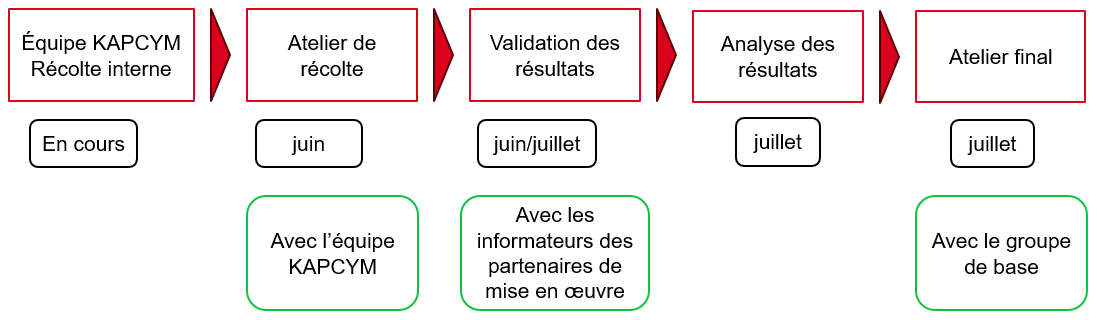
The KAPCYM Unit will conduct an Outcome Harvesting exercise to understand the effects of the KAPCYM Unit’s activities, i.e. what changes at the level of key stakeholders of the project are influenced by the Unit’s work. Using the complexity-sensitive evaluation method of Outcome Harvesting, the KAPCYM unit will systematically collect evidence of observed changes and then work backwards to determine whether and how the KAPCYM Unit has contributed to the change. The approach is especially suited for the evaluation of advocacy work, as it is designed to identify unknowns, including unintended outcomes, and analyses the significance of outcomes as well as the contribution of the KAPCYM mandate.
The KAPCYM Unit built an Outcome Database, where observed changes are continuously registered during the project. The identification occurs through observation during exchanges with key stakeholders, complemented by surveys and interviews. Outcomes are documented in a standardized format, explaining what changed, who did it (and contributed to it), and why the outcome is significant. Using this accumulated evidence, the Unit can map pathways of probable contribution and assess the effectiveness of its activities.
The KAPCYM Outcome Harvesting exercise will feed into an SDC evaluation of the KAPCYM Unit, which will take place in September 2026.
You can find a timeline of the Outcome Harvesting process here (note: the dates refer to 2026):

KAPCYM follows a gender-transformative approach by actively addressing and challenging unequal gender norms, roles, and power dynamics that affect CYM. Going beyond acknowledging gender differences, this approach aims to transform the structural factors that contribute to gender-based discrimination and exclusion.
As KAPCYM does not engage in direct implementation but instead supports the development of advocacy messages and policy dialogue, it systematically integrates gender across all KAPCYM processes and outputs, such as the thematic briefs, advocacy strategies, and stakeholder exchange mechanisms. Building on the experiences and insights of the EJM and EAMR projects, KAPCYM highlights gender-specific vulnerabilities and promotes good practices that foster equity and empowerment. The advocacy messages and exchange opportunities will not only promote gender equality as a goal but also contribute to shifting the power structures that maintain gender-based exclusion in migration and displacement contexts.
Documents by the EJM and EAMR Projects & other sources
Public Documents
Internal Documents
Internal EJM documents can be uploaded here.
Please do not share these documents externally.
Public Documents
Internal Documents
Internal EAMR documents can be uploaded here.
Please do not share these documents externally.
The KAPCYM Unit is a mandate of the Swiss Agency for Development Cooperation SDC.

Other pages related to KAPCYM


Sarah Estermann
Senior Advisor and Knowledge Manager MigrationCaritas SwitzerlandSwitzerland
+41 41 419 23 28sestermann@caritas.ch
Header image: © AI KAPCYM project cover 2024